 lukman-hakim
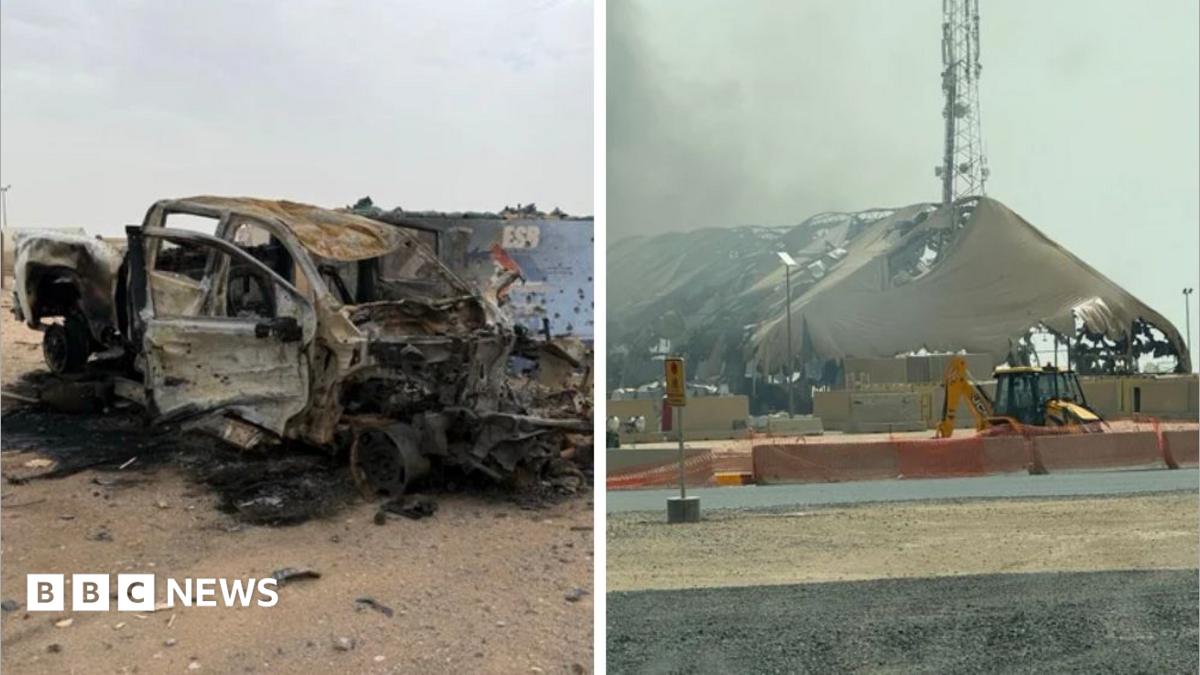
Newly disclosed photographs obtained by American media have revealed extensive physical damage across multiple United States military installations throughout the Middle East, offering a stark visual record of the impact of Iranian missile and drone strikes.
The imagery, provided directly by active-duty military personnel, depicts substantial destruction across various sites, ranging from a severed surveillance aircraft and flattened utility trailers to severely fractured multi-story buildings and incinerated vehicles. The undated photographs capture the aftermath of attacks at facilities situated in Saudi Arabia and Kuwait.
The visual evidence has spurred concern among military personnel on the ground regarding how the conflict is being portrayed. An unnamed service member cited by CBS News expressed deep frustration with the transparency surrounding the hostilities, asserting that major damage inflicted on regional bases has been withheld from the American public while stationed troops continue to endure incoming fire.
Following inquiries regarding the newly circulated images, the White House referred questions to United States Central Command, which did not immediately provide a formal response or statement regarding the visual documentation.
The emergence of the photos coincides with an official assessment published by the Department of Defense's inspector general, which verified that Iranian munitions have damaged or destroyed hundreds of structures and buildings across American military footprints in the region.
According to the Pentagon watchdog, the geographic scope of the destruction is extensive, with sustained Iranian bombardments affecting US installations located across Kuwait, Bahrain, Qatar, the United Arab Emirates, Saudi Arabia, Iraq, Oman, and Jordan over the course of the hostilities.
Among the most severe losses shown in the photographs is the wreckage at Prince Sultan Air Force Base, situated approximately 62 miles (100 kilometres) south-east of the Saudi capital of Riyadh. The images reveal a Boeing E-3 Sentry radar aircraft that has been ripped completely in half, with its rear fuselage and tail assembly crushed into a tangled mass of destroyed metal.
The Boeing E-3 Sentry Airborne Warning and Control System (AWACS) is a vital military asset designed to track distant airborne targets and deliver early warnings of incoming threats. The loss follows an earlier attack on the same Saudi airbase in March, during which a US official confirmed that 12 American service members were wounded, including two who sustained serious injuries.
Significant destruction was also documented at installations in Kuwait. At Camp Buehring, photographs show crumpled trailers, destroyed vehicles, and the smoking remnants of a large tented structure that had been shredded during an Iranian strike.
Further imagery shows structural damage to a four-storey facility at Camp Arifjan in Kuwait. That same installation had previously experienced documented damage in March, which affected critical satellite communications equipment, though it remains undetermined whether the latest photograph stems from the same offensive.
The material toll has introduced significant fiscal and logistical strains for the American military. The Pentagon watchdog reported that military equipment losses have climbed to an estimated $3.7 billion (£2.8 billion), contributing to an overall US expenditure of $33.4 billion (£24.7 billion) on the war through late June.
The watchdog further specified that dozens of American aircraft have been damaged or destroyed since the outbreak of hostilities. This total includes five specialized aerial refuelling aircraft that were struck and put out of commission on the ground in Saudi Arabia by Iranian munitions.
Economic assessments have underscored the immense cost of replacing specialized hardware. A separate report compiled by the Congressional Budget Office (CBO) noted that the E-3 Sentry is no longer in active production and will necessitate replacement with the newer E-7 platform, noting that an individual E-3 airframe carries a valuation of roughly $500 million (£371 million).
The CBO estimated the overall cost of equipment lost in combat operations at $1.9 billion (£1.4 billion), an accounting that encompasses destroyed airplanes, unmanned aerial vehicles, and a Terminal High Altitude Area Defense (THAAD) air defense battery.
The budget office highlighted that its calculations were subjected to analytical uncertainty because the Department of Defense did not supply answers to official inquiries, forcing analysts to rely on public records and government databases. As a consequence, the precise timeline and scope of planned reconstruction and military repairs remain ambiguous.
The revelation of the base damage comes at a time of mounting domestic political pressure on the White House to negotiate an end to the broader regional war. The conflict originally erupted on February 28 following joint US and Israeli military operations against Iran, prompting ongoing retaliatory Iranian strikes against Israel, Gulf partner nations, and American military personnel stationed across the region.









Comments (0)