

Three Years After October 7, Israelis Press for Accountability as Netanyahu Seeks Re-election
Three years after the deadliest single attack in Israel's history, residents of the communities along the Gaza border are still waiting for answers. On Wednesday morning, as dawn b
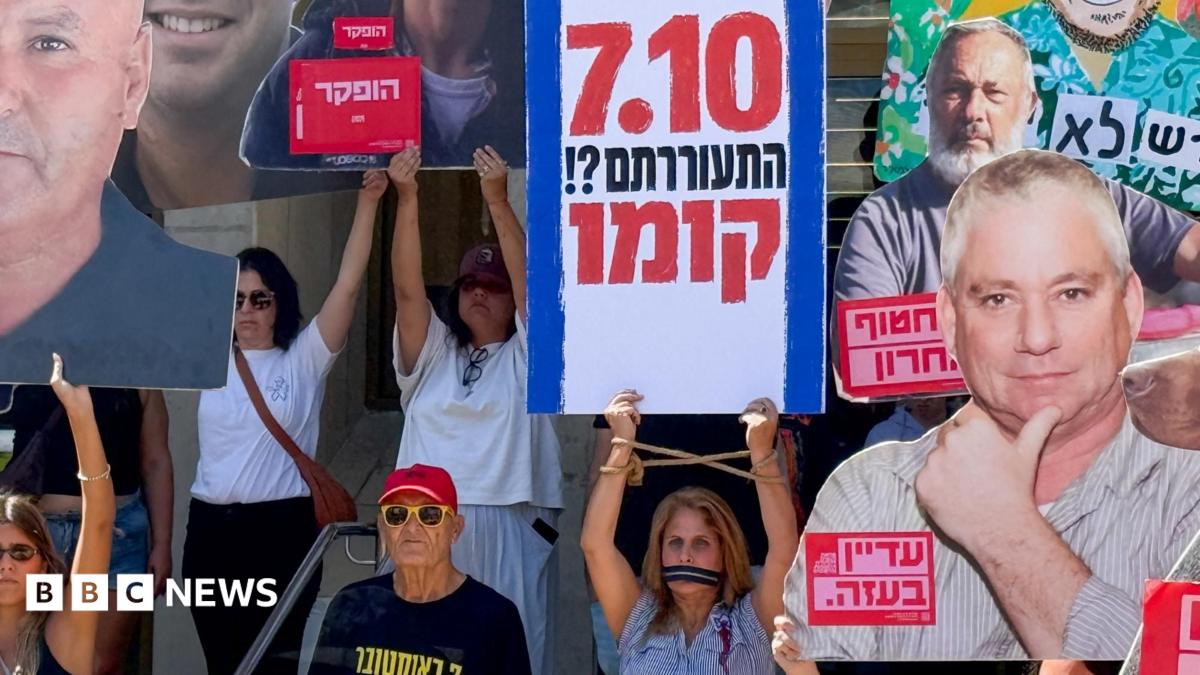
Three years after the deadliest single attack in Israel's history, residents of the communities along the Gaza border are still waiting for answers. On Wednesday morning, as dawn broke over the border area, mourners in Kibbutz Kfar Aza gathered silently around the community's armoury — the same spot where, shortly after 7am on 7 October 2023, Hamas-led gunmen killed half of the kibbutz's 14-member civil defence squad. In total, 64 people from Kfar Aza were killed that day and 19 were taken hostage into Gaza.
The anniversary ceremonies have revived a painful and unresolved debate in Israel: who bears responsibility for the catastrophic security failure that allowed the attack to happen? Roughly 1,200 people were killed across southern Israel when gunmen breached the border fence and overran multiple communities, and another 251 people were dragged back to Gaza as hostages. It was the worst loss of life Israel had suffered since the state's founding in 1948.
Three years on, no independent state inquiry has been established to examine how the attack was permitted to occur. That absence has become a central grievance for bereaved families, who argue that without a formal investigation, the lessons of October 7 will never be properly learned. "I need my country to take responsibility," said Inbar Goldstein, whose brother and niece were killed in the attack and four other relatives were kidnapped from Kfar Aza. She described the attack not as an isolated event but as the culmination of what she called a long process of abandonment, insisting that nobody had investigated its roots.
The question of accountability is inseparable from the political fate of Prime Minister Benjamin Netanyahu, who was in office at the time of the attack. He is now running for election once again, campaigning on the same core promise that has defined much of his career: that he is stronger and tougher than any rival when it comes to defending Israel from its enemies. For many Israelis, including families of the victims, that pitch sits uneasily alongside the failure of 7 October.
Suspicions that warnings went unheeded have only multiplied over the past three years. Reports have circulated that Netanyahu received advance alerts — from his own security chiefs as well as from regional neighbours — about Hamas's intentions. He has denied all such claims. Last month, the Israeli newspaper Haaretz published extracts from a new book alleging that the leader of the United Arab Emirates telephoned Netanyahu ten days before the attack to warn of Hamas plans for a major operation. Netanyahu's office dismissed the report as "an absolute lie" and said he would sue the newspaper.
The prime minister's allies have pushed back forcefully against suggestions that he could have known what was coming. Amir Ohana, a member of Netanyahu's Likud party, said in a social media video last month that the idea was "preposterous and absurd," pointing out that the former Hamas leader in Gaza, Yahya Sinwar, had shared details of the plan with only a handful of people. Ohana argued that Netanyahu had since reshaped the Middle East and had refused to give up "even when voices inside and outside Israel called on him to stop."
Netanyahu himself has directed blame at Israel's security establishment. He has accused his own security chiefs of deliberately choosing not to wake him in the hours before the attack, fearing he would order a massive deployment of the Israel Defense Forces and escalate the situation. In an interview with Israel's right-wing Channel 14 television network, he recounted the hypothetical concerns of his advisers — "God forbid we wake up the prime minister and he says, 'Wake up the entire IDF immediately, scramble the air force!'" — before suggesting that had he been alerted, the outcome would have been different and Israel would have been better protected.
But for relatives of those who died, the blame extends far beyond a single night. Among the dead was Roni Eshel, a young female soldier killed along with 14 members of her unit when gunmen overran their base at Nahal Oz, adjacent to Kfar Aza. She was one of a number of young women posted at observation bases along the Gaza border whose job was to monitor suspicious activity and report it up the chain of command. For months before the attack, they had warned their superiors about possible preparations for an assault.
Roni's uncle, Elad Levy, said the unanswered questions stretch back far beyond the day itself. He asked publicly whether the Egyptians or the Emiratis had warned the prime minister, and whether other warnings had been ignored. "We need to find out what happened — not just on the day, but the year before, and five years before that," he said. He added that the truth should be made clear, warning that if Israel does not inquire into these failures, "it will happen again and again."
The demand for a state inquiry has thus become both a moral cause for the bereaved and a live political issue ahead of the coming election. Families argue that a full, independent investigation is the only way to establish what intelligence was available, how it was assessed, what information reached military and political leaders in the run-up to the attack, and what the prime minister himself knew. Without that reckoning, they contend, the same systemic weaknesses could leave Israel exposed again.
For the people of Kfar Aza, the third anniversary is not simply a moment of remembrance but a renewed call for responsibility to be assigned. The community lost a quarter of its population in a single morning, and its surviving residents have spent three years rebuilding amid unanswered questions. As candles were lit and mourners embraced on Wednesday, the mood reflected a grief that has hardened into determination — a insistence that the country confront how October 7 was allowed to happen, and that those at the highest levels answer for it.
What's Your Reaction?
 Like
0
 Dislike
0
 Love
0
 Funny
0
 Wow
0
 Sad
0
 Angry
0

Editor Ekonomi. Mantan analis pasar modal. Spesialisasi: makroekonomi, kebijakan moneter, dan perdagangan internasional.




Comments (0)