 lukman-hakim
Republic of Ireland footballers will wear black armbands when they take on Israel in Debrecen on Sunday, honouring what the team described as "all lives lost in the Gaza conflict", after a tense squad vote confirmed the Nations League fixture will go ahead as scheduled.
The decision closes hours of speculation that the game might be cancelled following a protest withdrawal by goalkeeper Gavin Bazunu, who said he could not bring himself to play in the circumstances. Football Association of Ireland chief executive David Courell confirmed that one player had pulled out of the squad before the match and that a vote among the remaining players had returned a "significant majority" in favour of continuing with the fixture.
Courell said the armband gesture would be accompanied by other symbolic actions, with further demonstrations planned for the return "home" leg against Israel next Sunday in Serbia. That game, like the first, is being staged in neutral European territory rather than on Irish soil — a decision that drew criticism when the two sides were drawn together in Group B3 of the Nations League.
The arrangement became contentious because neither Israel nor Ireland wanted to host the tie, and the issue of whether any travelling supporters would be allowed was heavily scrutinised. Republic of Ireland players were also the target of an organised pushback campaign. A "Stop The Game" movement, organised by the pressure group Irish Sport for Palestine, called on the team to withdraw from the two fixtures because of the ongoing Israel-Gaza war, and those calls appear to have gained significant momentum inside and outside the dressing room.
One of the campaign's requests, Courell said, was that players be relieved of their media obligations for the rest of the international window. That would have stripped the squad of the usual round of press conferences and interviews, and its elevation as a bargaining point suggested the pressure on the players had become a matter of open dispute rather than private conscience.
Saturday's events unfolded in a way that looked, for a while, like a fixture falling apart. A pre-match news conference featuring manager Heimir Hallgrimsson and a player was due to begin at 09:15 BST, but it was cancelled roughly 15 minutes before its start. Reporters were told it would instead be held after training — a session that was also pushed back. Meanwhile, the players were holed up in a meeting at their hotel, having gone there after Bazunu's withdrawal became public and several team-mates voiced their own misgivings about fielding.
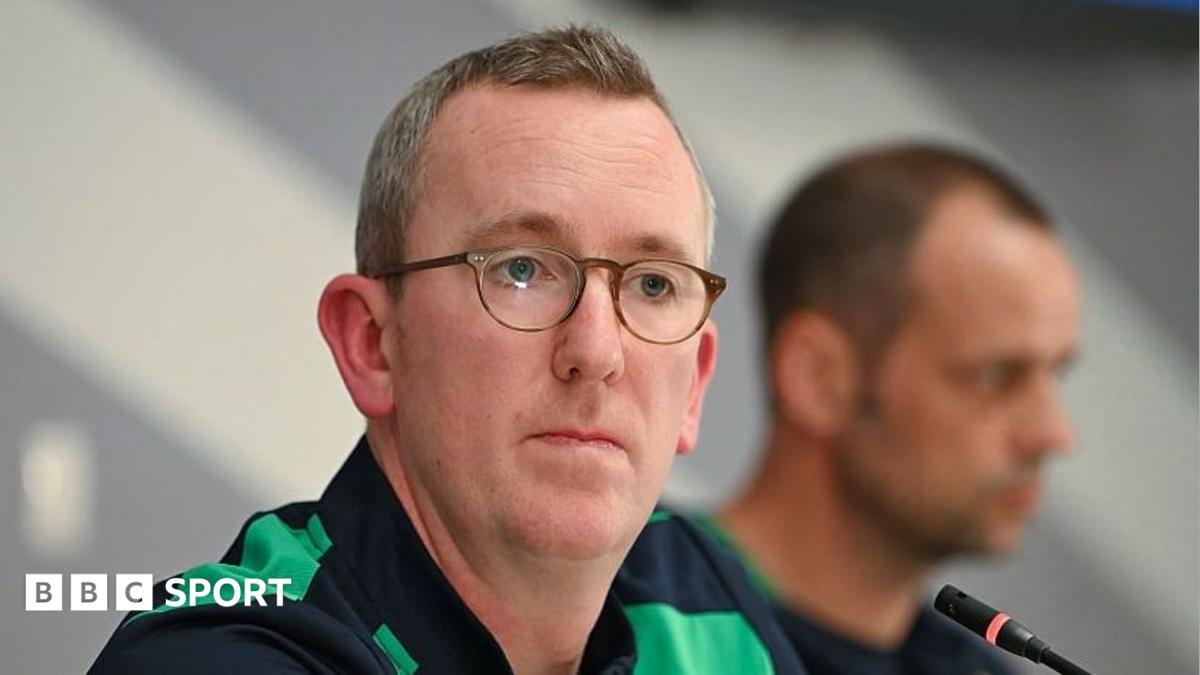
Around 13:00, players began to emerge from the meeting room, and it was confirmed the media session would go ahead after all, back at the Nagyerdei Stadion for 14:30, with training to follow. More than five hours after the original press conference was supposed to start, Courell — flanked by Hallgrimsson and FAI director of football John Martin — stood in front of the cameras to announce the outcome of the players' ballot.
He was careful to frame the process as a genuine debate rather than a fait accompli. "This morning, a player expressed their discomfort at the fixture and indicated their intent to withdraw," Courell said, adding that the shock of that decision demanded time for the rest of the squad to respond. What followed, he said, was four hours of conversations led by the players themselves, though with the coaching staff and the FAI executive also involved at various stages. "There were a lot of positions presented and the association is fully respectful of everyone's right to their respective opinion."
Alongside the armbands, Courell revealed that the Republic of Ireland would not take part in all of the pre-match ceremony — a refusal to participate in the official acknowledgements that many visitors decline to make for political reasons. The squad also intends to direct money to charity, with Courell pointing to donations built on the Israel match fees as well as the team's game against Austria at Dublin's Aviva Stadium on Thursday. That move effectively recycles the income from the fixture, giving the protest a practical as well as symbolic dimension.
Bazunu, the 30-year-old goalkeeper, explained his decision in a social media post in which he said the choice had not been taken lightly. He described himself as a man of strong faith who tries to be "a person of character and principle", and said participating in the fixtures would be wrong. His reasoning, he stressed, was personal conviction about the killing of innocent people, and he was at pains to make clear his stance was not directed at Israelis or the Jewish community but at what he called "the atrocities in the region". He added that opportunities to "stand up for something bigger" are rare in life, and believed this was one of them.
His exit nevertheless leaves the squad divided in a way that will be difficult to paper over. A dressing room that has voted to play while one of its members has walked away is a divided room, and the divisions are likely to surface in the coming weeks rather than being settled by the armbands. Courell's insistence on the "significant majority" is telling: it establishes that the decision carries a substantial mandate, but it also acknowledges that a sizeable minority — at minimum the absent goalkeeper, and by implication others who shared his concerns — was not on board.
That leaves Hallgrimsson managing a fixture in which the political statement is being made by his players rather than by his own bench. The BBC Sport summary of his position — "It's a situation you can't win" — captures the bind: the same game that the squad has agreed to play is the platform for a protest he cannot fully control, and any attempt to restrain the demonstration would be read as the manager overruling his own players.
For the FAI, the announcement is also a victory of a kind. Hosting both legs in neutral countries removed the most explosive element of the controversy, and delivering a vote, a demonstration and a charitable gesture at once allowed the association to present itself as responsive to player concerns while still honouring its fixture commitments. Whether that balance holds is another matter, with attention likely to turn to how the squad is selected for the return game in Serbia and whether more players follow Bazunu's lead.
The dispute has already become one of the most closely examined scheduling rows in recent Irish football, drawing comment from figures across the game, including former Republic of Ireland manager Brian Kerr and ex-international James McClean, and it is likely to remain so as the Nations League window concludes. What is certain is that Sunday's match in Debrecen will be played, and that it will be played with the squad's disagreement about Israel and Gaza made visible in the most public way available.









Comments (0)