 lukman-hakim
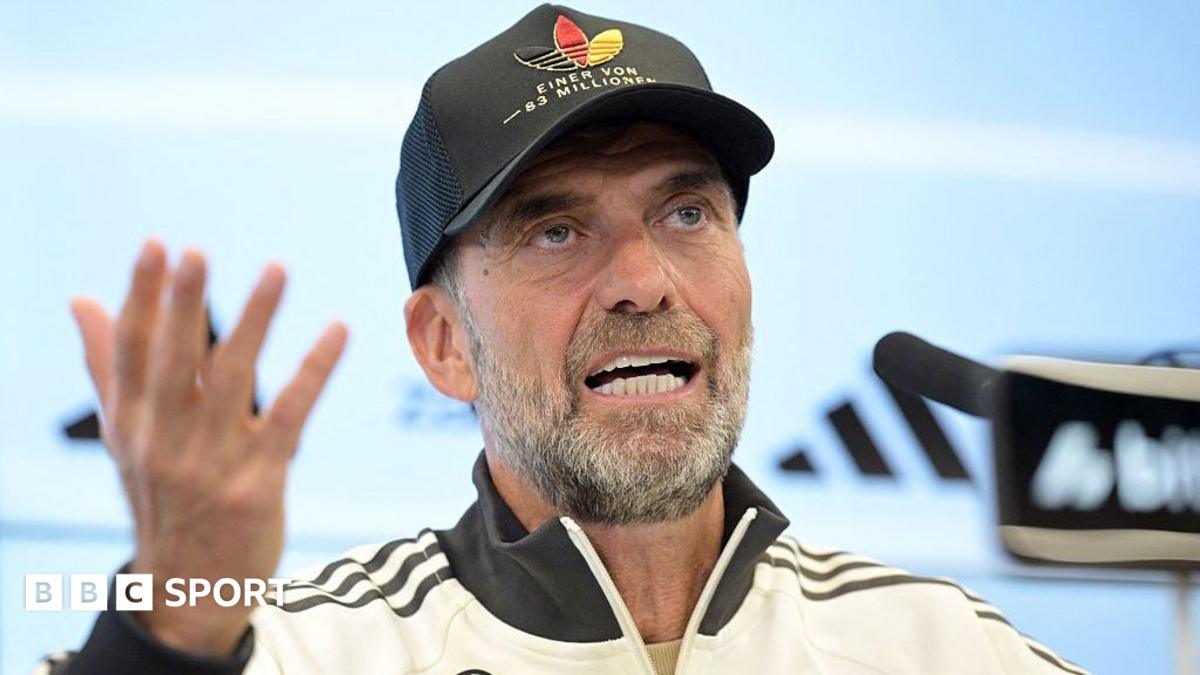
Jurgen Klopp has called on the German public to embrace an inclusive form of national identity, urging that the country's flag and national pride must not be surrendered to political extremists. Speaking publicly during the announcement of his first Germany squad, the newly appointed national team manager addressed the broader social climate following significant political gains by the far right in regional elections.
The manager’s remarks followed a notable electoral performance by the Alternative for Germany (AfD), an anti-immigration party that secured 43.8% of the vote in the eastern state of Saxony-Anhalt. That result left the party just short of an outright majority in the state parliament, with the organization also anticipating strong showings in upcoming regional elections scheduled in Berlin and Mecklenburg-Western Pomerania.
The rise of the AfD has drawn intense scrutiny across the country, given that no far-right political party has governed a German state since the end of World War Two and the fall of the Nazi regime responsible for the Holocaust. While acknowledging that he does not view himself as a political authority, Klopp used his platform to reflect on the divergent public reactions to the recent electoral shifts.
Addressing the media, Klopp expressed a clear desire from his sporting viewpoint to restore a unifying symbolism to the German flag. He explained that citizens waving the flag should not be met with suspicion or concern about their motives, but rather be seen as celebrating their good fortune to live in, grow up in, or migrate to the nation.
To articulate his vision, the former Liverpool manager introduced the concept of "positive patriotism" as a preferable alternative to traditional national pride, which he cautioned could easily be misinterpreted. Klopp emphasized that genuine pride in being German must go hand in hand with being open-minded, welcoming, diverse, and kind toward others.
Klopp also sought to keep sporting achievements in perspective, noting that having an adequate number of healthcare professionals and caregivers is ultimately far more vital to the country than football results. However, he maintained that the national team retains a unique capacity to generate community spirit and demonstrate the positive, unifying influence of sport during divided times.
On the sporting front, Klopp outlined an unconventional strategy to navigate a demanding international schedule, unveiling a massive 44-player squad that features 16 uncapped prospects. The expansive selection has been assembled to handle four UEFA Nations League fixtures scheduled across a congested two-week international window.
To manage player workloads, the German setup will be divided into two distinct groups. An initial contingent of 24 players will prepare for an away fixture against the Netherlands in Amsterdam on 24 September, followed by a home encounter against Greece in Augsburg three days later.
Following the opening two fixtures, the majority of the first group will be released back to their respective domestic clubs. A second wave of 20 players will then assemble to prepare for Germany's match against Serbia in Munich on 1 October, before concluding the international break with an away contest against Greece in Thessaloniki on 4 October.
The initial 24-man group features several notable England-based players, including Premier League trio Kai Havertz of Arsenal, Kevin Schade of Brentford, and Leeds United midfielder Anton Stach. Bayern Munich playmaker Jamal Musiala was also included in the selection after recovering from two separate collapses during pre-season fixtures with his club.
The second group includes a maiden senior international call-up for Brentford midfielder Vitaly Janelt. He will be joined by established names including Liverpool's Florian Wirtz and Newcastle United defender Malick Thiaw as part of the refreshed international roster.
Klopp's squad construction reflects a period of significant transition for the four-time World Cup winners, following a disappointing second-round elimination against Paraguay at the recent World Cup. That tournament exit prompted the international retirements of veteran pillars Manuel Neuer and Antonio Rudiger, necessitating a generational shift across the squad.
The World Cup setback also resulted in the dismissal of former head coach Julian Nagelsmann, opening the door for the German Football Association to recruit Klopp. Prior to accepting the national team role, Klopp had been serving as the global head of soccer for Red Bull, having previously ended his successful nine-year tenure at Liverpool in 2024.
With a congested fixture list ahead, Klopp faces the dual task of rebuilding Germany's tactical identity on the pitch while attempting to project a unifying, modern image of the national team off it. His first tests in the Nations League will provide an early measure of both his expansive squad rotation and his broader cultural vision for German football.







Comments (0)