 nadia-rahmawati
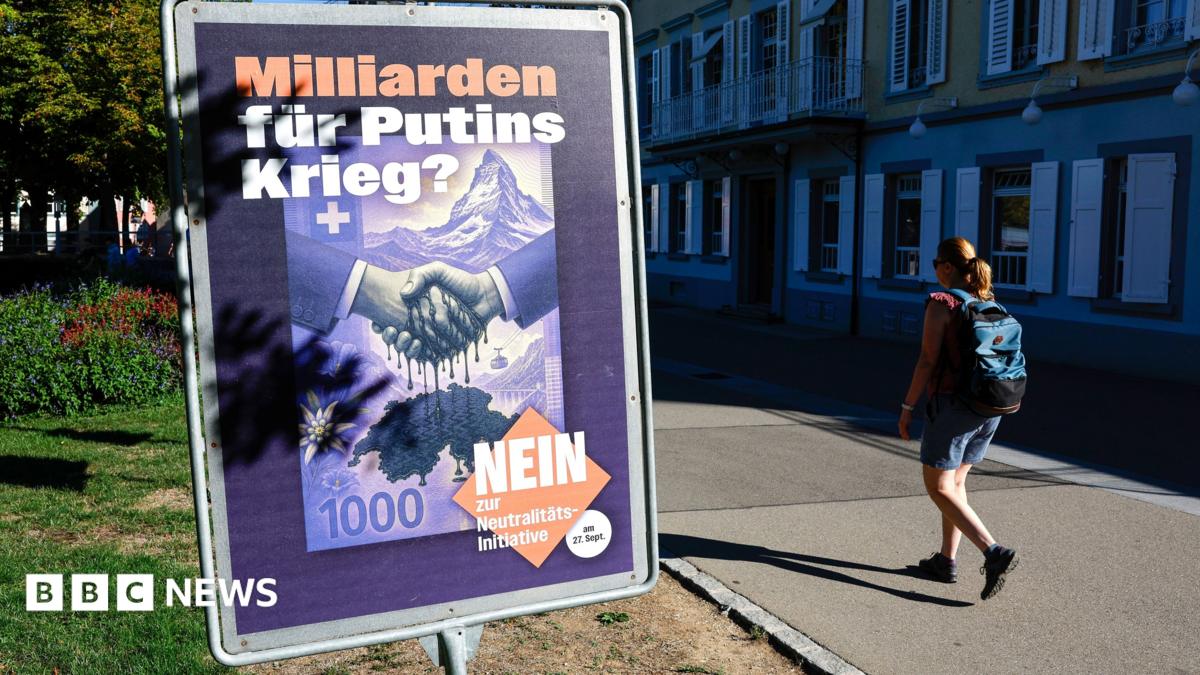
Swiss voters have decisively rejected a campaign to tighten the country's centuries-old tradition of diplomatic neutrality, official results showed, with more than 70% of those casting a ballot voting against the proposals.
The measures put to the electorate would have barred Switzerland from adopting sanctions unilaterally without first obtaining authorisation from the United Nations, and would equally have ruled out any move toward closer political or military alignment with the Nato alliance. Both elements were central to the "Neutrality Initiative", which supporters framed as a defence of the alpine nation's traditional non-alignment.
The vote caps a debate that has been reopened by Russia's full-scale invasion of Ukraine, which has pushed sanctions and European security into the centre of Swiss domestic politics. Moscow openly campaigned in favour of the initiative, a fact that appears to have done little to slow its appeal at the ballot box among voters who feared the country was drifting toward the Western bloc.
The proposal was championed by the right-wing Swiss People's Party, the SVP, the country's largest party in the national legislature. It was opposed by the federal government and by every other major party in parliament, warning that the initiative risked hollowing out a neutrality that, in their view, had survived because of its pragmatism rather than its strictness.
Analysts said the result should not be read as a repudiation of neutrality itself. Lukas Golder, co-director of the research institute Gfs.bern, told the Swiss public broadcaster SRF that the vote showed voters had not rejected the idea of being neutral, but rather had signalled support for Switzerland continuing to sanction Russia. "People have a clear idea of what Switzerland's neutrality is supposed to achieve," he said — a purpose, in his reading, that coexists comfortably with taking action against an aggressor.
That pragmatic view has long been the official position of the government. Foreign Minister Ignazio Cassis, appearing in a televised debate ahead of the vote, noted that neutrality "has always been applied with a degree of flexibility". He stressed that while Bern has no intention of lifting its prohibition on selling arms to countries engaged in conflict — including Ukraine — the principle does not imply passivity. Neutrality, he argued, does not mean indifference, and Switzerland would not turn away from what it sees as breaches of the very international rules that make peaceful life possible for its citizens.
Switzerland's special status is unusual. Its neutrality was internationally recognised in 1815, when the country was granted "eternal neutrality" at the Congress of Vienna, convened amid the upheaval of the Napoleonic wars. The arrangement was later given a legal definition in the Hague Convention of 1907, which prohibited the supply of weapons to states at war. That prohibition shaped Swiss practice for much of the 20th century, and includes a precedent with obvious contemporary resonance: Switzerland declined a German request for ammunition for tanks being sent to Kyiv.
The same rules, however, have coexisted with decisions that remain deeply contested at home and abroad. Switzerland stayed neutral throughout the Second World War. It accepted Nazi-looted gold, and in a move intended in part to forestall an invasion by Nazi Germany, it turned away thousands of Jewish refugees who sought entry. The government formally apologised for those policies in the 1990s, a reckoning that continues to shape debates over whether neutrality is best understood as solidarity with the vulnerable or as distance from their suffering.
The manner of the decision reflects the character of Swiss politics. Because the country operates a system of direct democracy, questions of this scale — including the relationship between national tradition and international obligations — are settled by referendums rather than left to legislators or executives alone.
The outcome leaves Switzerland's existing framework substantially intact, and the government retains room to pursue sanctions and European security cooperation as it has in recent years. But the margin of the defeat, and the fact that a party with substantial public support ran a campaign openly aligned with Moscow's preferred position, suggest the argument over where the limits of neutrality lie is far from settled. Voters backed a flexible reading of the principle; they did so, in effect, in full view of an unappealing precedent for what hard-line neutrality can look like in practice.









Comments (0)