 nadia-rahmawati
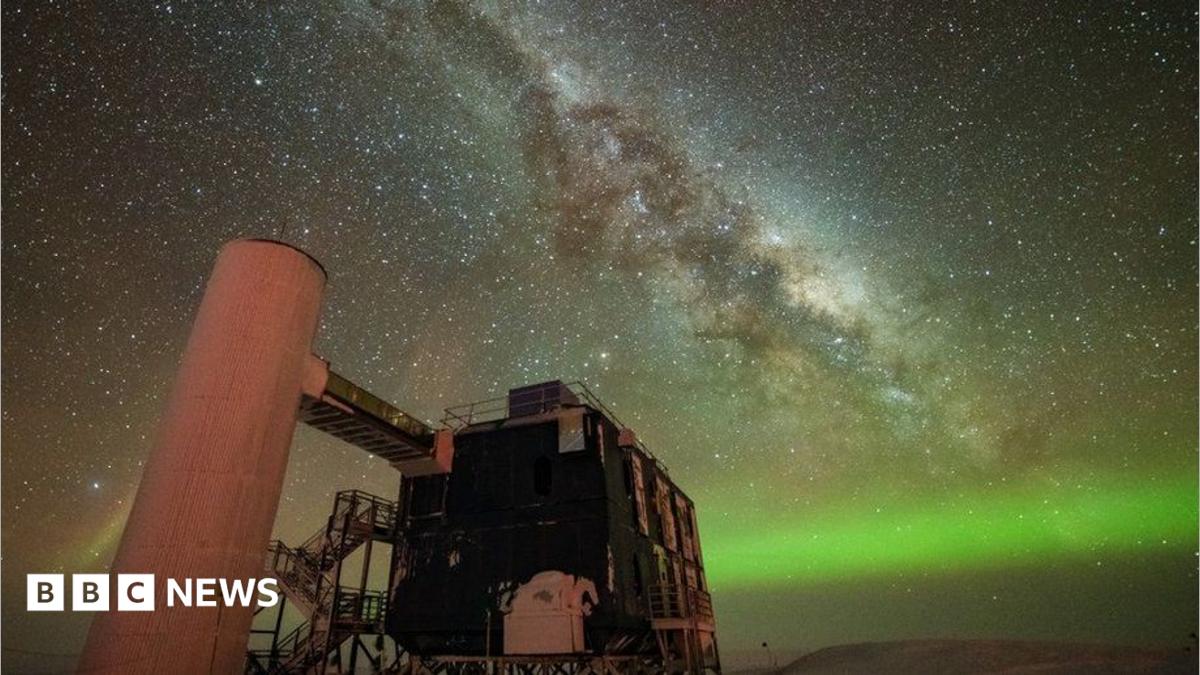
Belgian scientist Francis Halzen has been awarded the Nobel Prize in Physics for his groundbreaking efforts to build an extraordinary observatory beneath the Antarctic ice, a project that has opened an entirely new window onto the universe. The Royal Swedish Academy of Sciences announced the award on Tuesday, citing his "decisive contribution" to the development of the IceCube Neutrino Observatory and his decades-long pursuit of a scientifically daring idea.
The prize recognizes work that stretches back nearly four decades. Halzen first laid out his vision for detecting neutrinos from deep within the South Pole ice in 1988 — a proposal that many at the time regarded as imaginative but unlikely to succeed. The academy said his "vision and scientific leadership have been fundamental" to turning that concept into a functioning observatory, which has since become a cornerstone of a new branch of astronomy.
Speaking at a news conference following the announcement, Halzen expressed genuine astonishment at how far his idea had come. "I have to emphasise how lucky I was," he said, according to the BBC. "Because when we started this project, everybody realised this was maybe a good idea, but very few thought it would work, including myself." His candid remark underscored both the technical risks involved and the scale of the scientific payoff that has followed.
At the heart of the achievement is the neutrino, one of the most puzzling and abundant particles in existence. These subatomic particles are notoriously difficult to catch because they interact so rarely with ordinary matter. The Sun alone produces them in staggering quantities — every second, billions pass without effect through an area no larger than a human fingernail. That very elusiveness is what makes them valuable to scientists, since they can travel immense cosmic distances without being deflected or absorbed.
However, IceCube was not designed to study the relatively low-energy neutrinos streaming from the Sun. Instead, it hunts for far more energetic particles produced by violent events in distant galaxies, far beyond our own Solar System. These high-energy neutrinos act as astronomical messengers, carrying information about some of the most extreme processes in the cosmos — events that conventional telescopes struggle to observe directly.
The instrument itself is a feat of engineering on an almost unimaginable scale. IceCube consists of thousands of light sensors attached to long cables, which were drilled deep into the Antarctic ice and then left to freeze in place, creating a detector spanning a full cubic kilometre. The choice of location was no accident: the clarity and sheer volume of the polar ice sheet made it an ideal medium for capturing the faint signals the team hoped to find.
The detection process relies on rare and fleeting interactions. Most neutrinos pass straight through the ice without leaving a trace, but on occasion one will collide with an atomic nucleus. When that happens, fast-moving charged particles are produced, and as they race through the ice they emit a distinctive blue glow. Sensitive detectors embedded in the ice can pick up that light, allowing researchers to register the event.
Crucially, the pattern and timing of that faint flash enable scientists to estimate the direction from which the neutrino arrived, offering clues about its origin somewhere in the distant universe. Because these interactions are so uncommon, the observatory required an enormous expanse of clear ice to have any realistic chance of catching enough of them. Halzen's solution — using a vast natural ice sheet rather than constructing an artificial detector — was both audacious and ingenious.
The significance of the work has been widely acknowledged within the scientific community. Prof Mark Pearce, chair of the Nobel Committee for Physics, praised Halzen's leadership and persistence. "Francis Halzen has led an international team of researchers and engineers who have provided us with a fantastic instrument," Pearce said. "His tenacity and scientific vision has paved the way for a new kind of astronomy."
IceCube's scientific output has already produced striking results. One notable image released by the collaboration showed the Milky Way — but rather than being composed of starlight, the blurry picture was built from neutrino particles. That achievement illustrated how neutrino astronomy can complement and extend what is possible with more familiar forms of observation, revealing aspects of the galaxy that would otherwise remain hidden.
The award also highlights the collaborative nature of modern big-science projects. IceCube has drawn together an international team of researchers, engineers and technicians, whose combined efforts transformed Halzen's original proposal into a working observatory at the geographic South Pole. The prize thus reflects not only one scientist's vision but also the sustained, collective work required to realize it.
Neutrino astronomy remains a young field, and its potential is far from exhausted. By tracing these ghostly particles back to their sources, researchers hope to learn more about the extreme conditions that generate them — environments that no ordinary telescope can easily examine. The Nobel Committee's recognition signals confidence that this approach will continue to yield insights into the most energetic phenomena in the universe.
For Halzen, the honor arrives after a career defined by persistence against skepticism. His willingness to pursue an idea that few believed would work has now been validated by the highest accolade in physics. The observatory he championed stands as a monument to the value of long-term scientific ambition, and it promises to keep delivering discoveries about the cosmos for years to come.






Comments (0)