 lukman-hakim
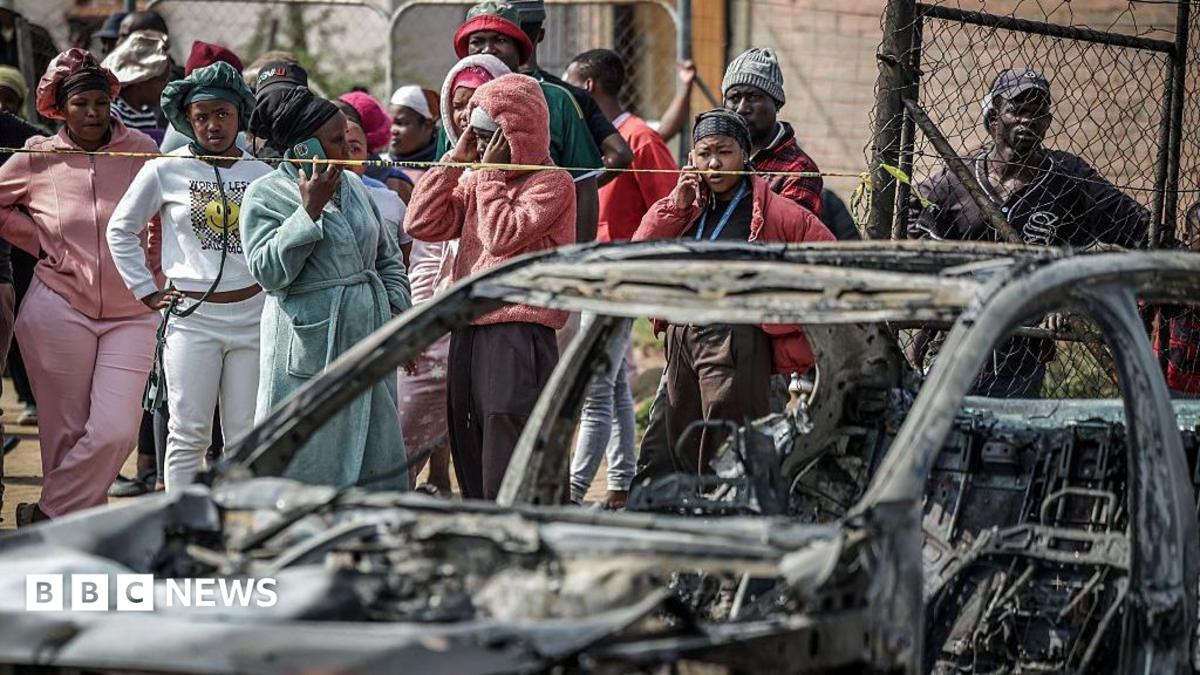
Twenty-seven people are dead after two mass shootings less than 12 hours apart in South Africa, in what is the latest eruption of gun violence in a country that has long struggled to rein in illegal firearms and organised crime. The attacks — one at a bar outside Johannesburg on Saturday evening and one outside an entertainment venue in a township near Cape Town in the early hours of Sunday — left a further 26 people wounded and prompted renewed scrutiny of a crime wave that officials say is steadily worsening.
In the first attack, eight gunmen descended on a bar close to Johannesburg at nightfall, according to police. Witnesses described the men opening fire on customers gathered outside before pushing their way inside and continuing to shoot. Before fleeing, the gunmen set fire to two vehicles at the scene, in what investigators suggested was an attempt to destroy evidence or hinder pursuit. Police said the victims were 13 men and four women. Fifteen people were taken to hospital with injuries.
The circumstances surrounding the Johannesburg attack remain unclear, with officers declining to publicly identify a motive. Deputy provincial police commissioner Maj Gen Fred Kekana, speaking at the scene, said the killings may have been retaliation for an incident a month earlier in which one person was killed and another was wounded. Kekana, whose remarks were reported by the AFP news agency, said investigators had clear photographs of the suspects and, in some cases, their names — a claim that will be tested by whether arrests actually follow.
The second attack took place in the small hours of Sunday morning outside an entertainment venue in a township on the outskirts of Cape Town. Ten people were killed and 11 more were injured. Unlike the Johannesburg attack, some of the wounded died later: five victims died at the scene and a further five succumbed to their injuries in hospital. Armed security personnel were deployed to the area as police began their investigation. As of Sunday morning, no arrests had been made in connection with either shooting.
The double attack came just days after 11 people were killed in Durban, where gunmen stormed a house in the KwaMakhutha township. Taken together, the three incidents have killed 38 people in less than a week, a sequence that has reinforced fears that the country's already severe gun-crime statistics are deteriorating rather than stabilising.
That context is not difficult to find. South Africa has one of the highest murder rates in the world, and roughly 60 people are killed by homicide every day in a population of about 62 million. Illegal weapons are widely available, a product of decades of poorly controlled gun trafficking through the country's ports and borders, and the resulting violence has become closely intertwined with criminalised economies rather than with ordinary interpersonal disputes. Analysts and commentators frequently point to turf wars between gangs competing over drug trafficking and illegal gold mining as a principal driver of the country's deadliest shootings, with rival groups using automatic weapons to settle disputes that local policing is often unable to address.
The government has publicly acknowledged the scale of the problem. In February, President Cyril Ramaphosa described organised crime as "the most immediate threat to our democracy, our society and our economic development", a characterisation that speaks to the economic cost of the violence as much as its human one. Earlier this year the military was deployed alongside police in several of the areas with the country's highest murder rates, an unusual step aimed at reducing armed violence by putting additional firepower and manpower on the streets.
Police say they have not indicated a motive for either weekend attack, and the possibility that the Johannesburg and Cape Town killings were linked to the same criminal networks has not been established. What is clear is the pattern: attacks on seemingly ordinary public gathering places — a bar, a nightclub — at times of heavy footfall, carried out with military-level coordination and, in at least one case, followed by an attempt to conceal evidence.
Separately, police in Ekurhuleni, east of Johannesburg, said on Saturday that they could not rule out the presence of a serial killer after a tenth woman's body was found in the area. Officers acknowledged similarities between some of the deaths but stressed the investigation was continuing. The discovery came on the same weekend as the two mass shootings, adding to a sense of insecurity in the greater Johannesburg region.
Investigators face an uphill task. While police say they have images and, in some cases, identities of the Johannesburg suspects, South African authorities have a long record of failures to secure convictions in gang-related killings, a problem that has entrenched the turf-war dynamics fuelling the violence. Without arrests, the weekend's two attacks — and the Durban massacre before them — risk being added to a long ledger of unsolved mass killings.
For now, the immediate focus is on the families of the dead and the injured in both cities, while investigators work through CCTV footage, phone data and the photographs police say they hold. What the weekend has made plain is that the measures taken so far, including the military deployment, have not been enough to interrupt a cycle of violence that is now claiming lives at a pace of close to two dozen a day.
The distinction between public terror and organised crime is also narrowing, as gun attacks on bars and entertainment venues increasingly place ordinary, unarmed civilians at the centre of a dispute that is not theirs. Whether that trend continues unchecked, or whether the arrests promised by police finally materialise, is likely to define South Africa's response in the weeks ahead.








Comments (0)